If you are deciding whether the winter sonata korean drama series is worth your time, treat it as a classic romantic melodrama rather than a modern fast-cut K-drama. Its story is built around first love, loss, memory, and reunion, and its importance comes as much from its Korean Wave legacy as from the romance itself.
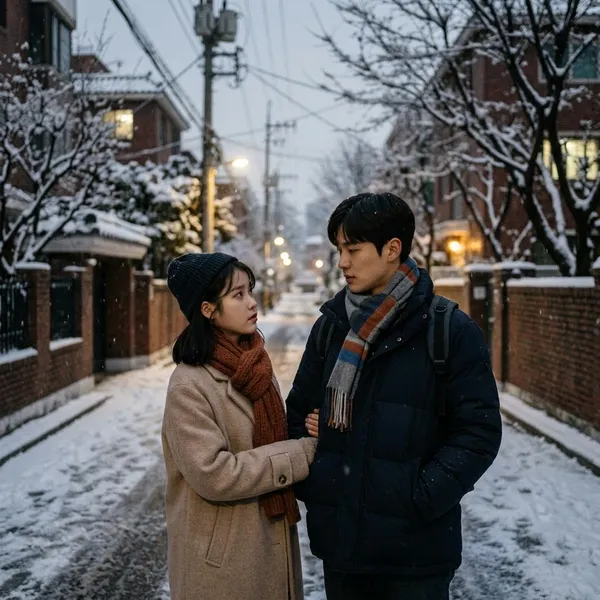
What is Winter Sonata about?
Winter Sonata follows Jung Yu-jin and Kang Joon-sang, two teenagers whose first love is cut short by a tragic accident. Years later, Yu-jin meets Lee Min-hyung, a man who looks exactly like Joon-sang but seems to have no memory of her.
Joon-sang and Yu-jin fall in love as teenagers
The romance begins in their school years, when Joon-sang arrives as a quiet, guarded student and Yu-jin gradually becomes the person who reaches him. Their connection grows through small moments rather than dramatic declarations, which gives the early episodes their nostalgic pull.
If you enjoy youth romance built on atmosphere, music, and unspoken feelings, this opening stretch is one of the drama's strengths. If you prefer immediate plot momentum, it may feel gentle at first, but those early memories are what make the later heartbreak matter.
A car accident separates the young couple
A car accident appears to take Joon-sang out of Yu-jin's life, leaving her with a loss she never fully processes. The accident is not just a shock twist; it becomes the emotional wound that shapes her adult choices.
The important thing to watch for is how the drama treats grief as unfinished time. Yu-jin grows up, works, and tries to move forward, but emotionally she is still tied to the boy she lost.
Min-hyung's arrival brings the past back
When Yu-jin meets Lee Min-hyung years later, his resemblance to Joon-sang unsettles everything she thought she had accepted. He looks familiar but does not respond like someone who remembers her, which creates the central tension of the adult storyline.
- For Yu-jin: he reopens a love she thought was impossible to revisit.
- For Min-hyung: her reaction raises questions he cannot easily explain.
- For the people around them: the past becomes a threat to present relationships.
Memory and identity reshape their relationship
The most interesting part of Winter Sonata is not simply whether Yu-jin and Joon-sang can be reunited. It is whether a person is still the same person when memory, behavior, and emotional history no longer line up neatly.
Who stars in Winter Sonata?
The main cast is a big reason the drama became so memorable. Winter Sonata depends on restrained emotion, longing glances, and unresolved tension, so the performances need to feel sincere rather than flashy.
The central pairing is Bae Yong-joon and Choi Ji-woo, supported by Park Yong-ha and Park Sol-mi in roles that deepen the love triangle and social pressure around the leads.
Bae Yong-joon as Joon-sang and Min-hyung
Bae Yong-joon plays both Kang Joon-sang and Lee Min-hyung, making him the emotional and narrative hinge of the series. Joon-sang feels closed-off and wounded, while Min-hyung appears more polished and adult, even when something about him feels unresolved.
His performance became one of the defining images of early Hallyu. In Japan, his popularity grew so large that he became widely known as Yon-sama, a nickname closely tied to the drama's cultural impact.
Choi Ji-woo as Yu-jin
Choi Ji-woo gives Yu-jin the warmth and sadness the story needs. She plays her as someone trying to live responsibly in the present while carrying a past that still has emotional power.
What makes Yu-jin work is that she is not only "the woman who cannot forget." She is practical, loyal, conflicted, and sometimes painfully hesitant, which makes her choices feel human even when the plot becomes very melodramatic.
Park Yong-ha as Sang-hyuk
Park Yong-ha plays Kim Sang-hyuk, Yu-jin's longtime friend and fiancé. He represents the stable life Yu-jin is expected to choose, but his position is more complicated than a simple romantic obstacle.
Sang-hyuk's frustration comes from loving someone whose heart is still partly elsewhere. That makes his scenes uncomfortable in a believable way, especially for viewers who have seen a relationship struggle under the weight of an old attachment.
Park Sol-mi as Chae-rin
Park Sol-mi's Chae-rin brings sharper tension into a drama that often moves through quiet sorrow. She is proud, stylish, and competitive, but her role is not limited to jealousy.
Her choices add pressure to the central romance and remind viewers that unresolved love does not only hurt the main couple. It spills into friendships, engagements, and social expectations around them.
Why is Winter Sonata so famous?
Winter Sonata is famous because it became both a beloved romance and a turning point for the Korean Wave. Its success showed that Korean dramas could travel across borders not just as entertainment, but as a whole fan culture built around actors, music, locations, and emotional storytelling.
Its Japanese success helped expand the Korean Wave
Japan was central to the drama's legacy. When Winter Sonata aired there, it attracted a passionate audience and helped introduce many viewers to Korean television in a lasting way.
The impact went beyond ratings. Fans bought DVDs and soundtracks, followed cast news, and visited filming locations, turning the drama into an early example of how K-drama fandom could support tourism and celebrity culture.
Bae Yong-joon became a major Hallyu star
Bae Yong-joon's rise through Winter Sonata matters because it showed how a Korean actor could become a major cross-border celebrity. His image as calm, gentle, and emotionally restrained fit the drama perfectly and became a huge part of its appeal.
Its first-love story connected with viewers across Asia
The first-love theme made the drama easy to understand across cultures. Viewers did not need detailed background knowledge of Korea to connect with longing, regret, missed timing, and the feeling that one early relationship can shape adulthood.
That emotional accessibility is one reason Winter Sonata became a gateway drama. A viewer who came for romance could stay for the mood, the music, and the question of whether the past can ever truly be restored.
Its winter scenery became part of its identity
The snow, tree-lined paths, muted colors, scarves, and quiet outdoor scenes are not just pretty decoration. They give the drama its emotional temperature: beautiful, still, and slightly painful.
This is also why the locations became so closely tied to the drama's memory. For many fans, Winter Sonata is remembered almost as much through its winter images as through specific plot points.
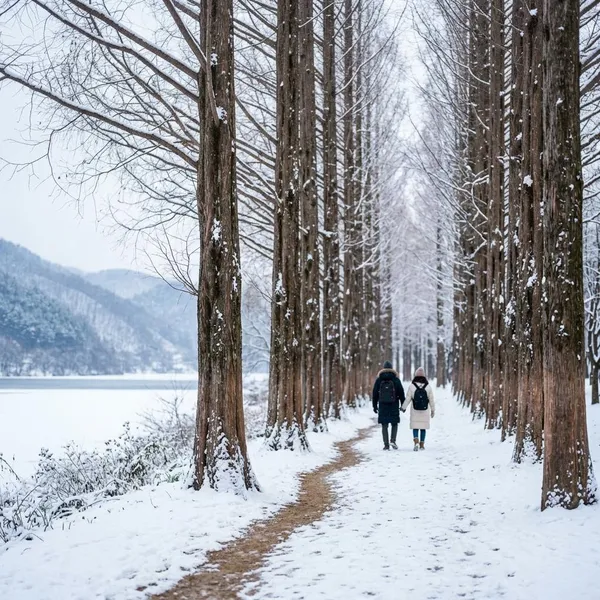
Where was Winter Sonata filmed?
Winter Sonata was filmed in several places that later became closely linked to Korean drama tourism, especially Nami Island, Chuncheon, and Yongpyong Ski Resort. These locations matter because they shaped the drama's romantic mood and later became part of its fan experience.
Nami Island became its most famous filming location
Nami Island is the location most strongly associated with Winter Sonata. Its long tree-lined paths and seasonal scenery became iconic after the drama's success, especially for international fans visiting Korea.
Chuncheon provided key romantic settings
Chuncheon is closely tied to the school-age part of the story, where Joon-sang and Yu-jin first meet and form the memories that later define the drama. Its quieter atmosphere suits the nostalgic tone of the early episodes.
Yongpyong Ski Resort featured in memorable scenes
Yongpyong Ski Resort adds the broader winter setting that many viewers associate with the adult part of the drama. Its snowy landscape supports the series' polished romantic mood and gives some scenes a more cinematic scale.
If you are choosing only one location for a fan visit, Nami Island is usually the priority. Yongpyong is more appealing if you specifically like the ski-resort atmosphere or want to connect the drama with a winter travel plan.

Is Winter Sonata still worth watching?
Winter Sonata is still worth watching if you like classic romantic melodrama, early 2000s K-drama style, or Korean Wave history. It is less suitable if you want sharp pacing, modern dialogue, constant plot twists, or a romance that feels contemporary from the first episode.
It suits fans of classic romantic melodrama
This drama is a good fit for viewers who like romance without irony. It leans fully into fate, separation, sacrifice, longing, and emotional sincerity.
If your favorite K-dramas are quieter, sentimental, or built around a painful first love, Winter Sonata will probably feel rewarding. If you usually prefer romantic comedy or high-energy ensemble stories, it may feel too solemn.
Its slower pacing reflects early 2000s K-dramas
The slower pacing is one of the biggest things modern viewers need to prepare for. Scenes linger, emotions are revisited, and the soundtrack often carries the feeling instead of dialogue moving everything forward quickly.
That is not automatically a flaw, but it changes how you should watch it. It works better as an evening melodrama you settle into than as a show you expect to binge for rapid twists.
Its first-love story still carries emotional weight
The central feeling still holds up: someone from the past can remain emotionally present long after life appears to have moved on. That is why the drama can still affect viewers even when some plot devices feel dated.
Yu-jin's conflict is especially relatable if you have ever seen someone choose between a stable present and an unresolved attachment. The drama heightens that situation, but the emotional question is still recognizable.
Its Hallyu legacy adds historical appeal
For viewers interested in Korean entertainment history, the legacy alone gives Winter Sonata extra value. It shows an earlier stage of K-drama export success, before global streaming made Korean series easy to find everywhere.
Watching it now can feel like looking at the roots of familiar K-drama patterns: emotional soundtracks, memorable locations, star-centered fandom, and romance built around fate and memory.
Conclusion
Winter Sonata is worth approaching with the right expectations: not as a modern romance designed for speed, but as a landmark melodrama with sincere emotion, iconic winter imagery, and real historical weight. If you want a classic K-drama that explains why early Hallyu mattered, it remains one of the clearest places to start.