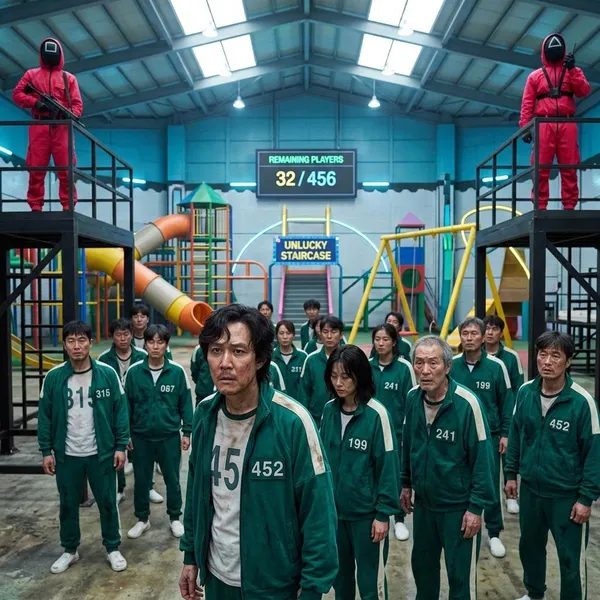
The squid game drama series is a Korean survival thriller about desperate people playing children's games for a life-changing prize, with death as the penalty for losing. If you are deciding whether to watch it or trying to understand why it became so big, the key is this: the games are simple, but the story is really about debt, power, guilt, and what people do when every option is bad.
What is the Squid Game drama series?
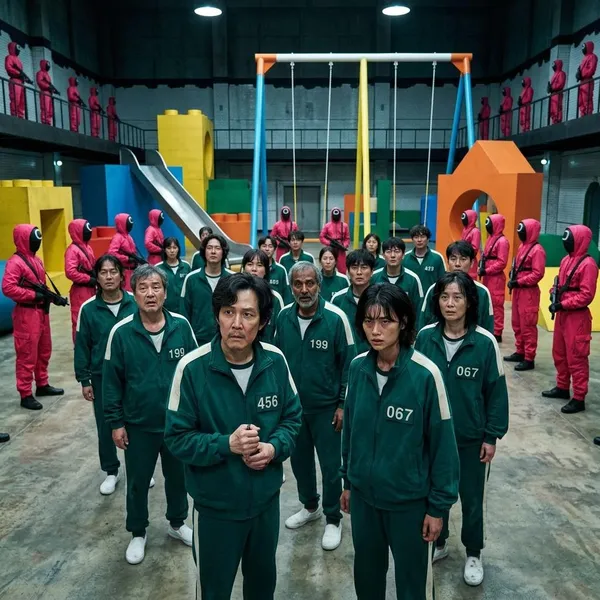
Squid Game is a South Korean survival drama created by Hwang Dong-hyuk. The premise is easy to grasp: contestants with serious financial problems are invited into a hidden competition where familiar childhood games become deadly tests.
A Korean survival thriller created by Hwang Dong-hyuk
Hwang Dong-hyuk built the series around very recognizable fears: debt, shame, unstable work, family pressure, and the feeling that society has already decided who gets to be safe. Those details come from a Korean setting, but they are not hard for international viewers to understand.
Three seasons tell one complete story
The series is best understood as one long arc across three seasons. Season 1 pulls Gi-hun into the games, Season 2 pushes him toward confrontation, and Season 3 brings the larger conflict to its final round.
- Watching for plot: go in season order, because later choices depend on Gi-hun's guilt and trauma.
- Watching for themes: pay attention to who benefits from the games, not only who survives them.
- Watching after spoilers: the tension still works because many scenes are about moral pressure, not surprise alone.
Deadly childhood games drive the competition
The childhood games are the show's smartest hook. Their rules are simple, so viewers do not get lost in complicated mechanics. Instead, the fear comes from seeing something playful turned into a controlled system of elimination.
That contrast also gives the series its bite. Games associated with fairness and innocence become a way to expose how unfair adult life can be. A player may technically face the same rules as everyone else, but strength, alliances, information, luck, and desperation still shape the outcome.
What happens in Squid Game?
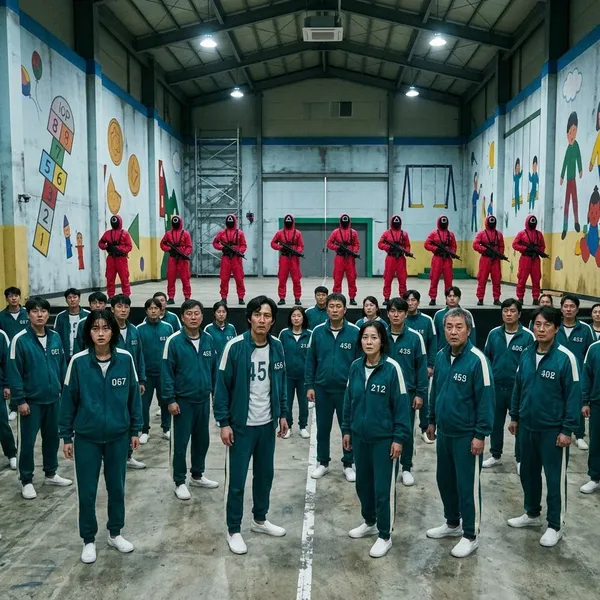
Squid Game follows Seong Gi-hun from a desperate contestant into someone who can no longer ignore the system that nearly destroyed him. The story begins with survival, but it gradually becomes a fight over whether the games can be exposed or stopped.
Season 1 brings Gi-hun into the games
Season 1 starts with Gi-hun at a low point. He is in debt, unreliable, and losing his grip on the people he cares about. When he is offered a chance to win a huge cash prize, the offer is dangerous, but his normal life already feels impossible.
For a first-time viewer, this is the season where you should avoid character spoilers if possible. The emotional force depends heavily on not knowing which relationships will hold and which ones will break.
Season 2 sends Gi-hun back to stop them
Season 2 changes Gi-hun's role. He is no longer just a man trying to escape the arena. He has seen the cost of the prize and cannot treat his survival as a clean ending.
This shift makes the story more about resistance than competition. The games still matter, but the larger question becomes harder: how do you fight an organization built on secrecy, money, discipline, and people who already know how to erase evidence?
Season 3 brings the story to its final round
Season 3 serves as the closing stretch of the series' main conflict. It pulls together Gi-hun's trauma, the hidden structure behind the games, and the uncomfortable question of whether one person's resistance can matter against an institution designed to outlast its victims.
Main Squid Game cast and characters
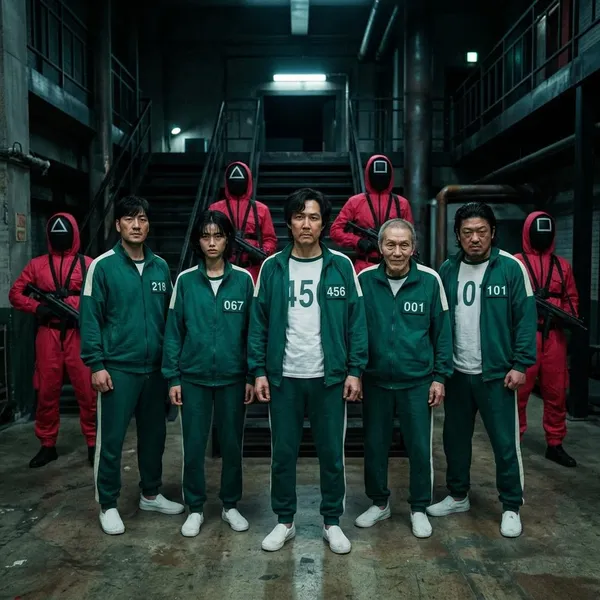
The Squid Game cast is a big part of why the premise feels human instead of gimmicky. The actors give the contestants and power figures enough emotional detail that the violence never plays as spectacle alone.
Lee Jung-jae as Seong Gi-hun
Lee Jung-jae makes Gi-hun compelling because he does not play him as a polished hero. Gi-hun is messy, scared, often disappointing, and still capable of kindness. That mix is what makes his later shift toward resistance feel earned rather than heroic by default.
Lee Byung-hun as Hwang In-ho
Lee Byung-hun gives Hwang In-ho a controlled, unsettling presence. The character matters because he shows that power in Squid Game is not always loud or chaotic; sometimes it is calm, procedural, and protected by people who understand exactly how the system works.
Wi Ha-jun as Hwang Jun-ho
Wi Ha-jun's Hwang Jun-ho gives the audience a route outside the contestant experience. His investigation raises the practical question many viewers naturally ask: if the games are so huge and violent, why are they so hard to expose?
That storyline adds scale. It shows that the danger is not limited to the arena; it is also in the planning, secrecy, surveillance, and loyalty that keep the operation hidden.
Jung Ho-yeon as Kang Sae-byeok
Jung Ho-yeon's Kang Sae-byeok stands out because so much of the performance is restrained. Sae-byeok does not need long speeches to show fear, care, or exhaustion. Small reactions tell you she has learned to survive by revealing very little.
Park Hae-soo as Cho Sang-woo
Park Hae-soo plays Cho Sang-woo as intelligent, ashamed, and increasingly dangerous under pressure. His arc is not a sudden turn from good to evil. It is a series of choices that become easier for him to justify as the stakes rise.
That makes Sang-woo one of the show's most useful characters for thinking about morality. He shows how survival logic can make terrible decisions feel practical in the moment.
What themes does Squid Game explore?
Squid Game explores debt, inequality, survival ethics, and dehumanizing power. The violence is shocking, but the reason it stays with people is that the show keeps connecting the games to pressures that exist outside the arena.
Debt and economic inequality
Debt is the pressure that makes the invitation work. Most contestants do not enter because they want adventure. They enter because their lives have narrowed so much that a deadly chance starts to look like a possible exit.
This is where the series becomes more uncomfortable than a normal thriller. The outside world is not shown as a fair place interrupted by a cruel game. It is already harsh enough that the game can present itself as an opportunity.
Morality and survival
The series keeps asking what people owe each other when survival is on the line. A kind choice may save someone in one round and become a weakness in the next. A selfish choice may be horrifying, but the structure of the game is designed to make selfishness useful.
That is why character debates around Squid Game tend to last. The show does not hand viewers a clean moral scoreboard. It puts people in conditions where fear, loyalty, shame, and strategy collide.
Power and dehumanization
Power in Squid Game often works by stripping people down to roles. Contestants become numbers. Guards become masked functions. Wealthy observers are separated from the suffering they consume as entertainment.
- Uniforms: reduce personal identity and make control easier to enforce.
- Numbers: turn contestants into units instead of people.
- Rules: make cruelty look orderly, almost administrative.
- Spectacle: turns desperation into something others can watch.
Childhood games as social commentary
The childhood games are not just a visual trick. They make the show's criticism easier to feel. Something that should belong to play, memory, and fairness becomes a weapon for ranking and removing people.
For a casual viewer, that makes the tension immediate. For a theme-focused viewer, it adds another layer: the series suggests that competition can look innocent until the consequences become impossible to ignore.
Why did Squid Game become a global hit?
Squid Game became a global hit because it is easy to understand, visually unforgettable, emotionally direct, and open to debate after each episode. It works for viewers who want a tense survival story and for viewers who want something sharper about money, power, and social pressure.
A simple high-stakes premise
The basic pitch is brutally clear: people in debt play deadly children's games for money. That simplicity matters. A viewer does not need deep lore, a franchise background, or cultural homework to understand the stakes.
Simple also makes the show easy to recommend. Someone can hear the premise, try one episode, and immediately know whether the tension is for them.
A distinctive visual style
The pink guards, green tracksuits, geometric masks, giant playground spaces, and bright staircases gave the series instant recognition. Even people who had not watched it could identify the imagery online, in costumes, or in short clips.
The style is not only branding. The cheerful colors make the violence feel more disturbing because the setting keeps pretending to be playful while functioning like a machine.
Characters built around universal struggles
The characters are rooted in specific lives, but their pressures are widely recognizable: unpaid debt, family disappointment, social shame, fear of failure, and the hope that one win could fix everything.
This is important for viewers who are unsure whether the show is "just violent." The violence is intense, but the reason many people stay invested is that the characters' choices feel emotionally legible before the games even begin.
Suspense that works across cultures
The suspense works because the rules are visible and the danger is immediate. You can understand the terror of moving at the wrong time, choosing the wrong partner, trusting the wrong person, or running out of time without needing translation notes.
There is also a second kind of suspense: moral suspense. Viewers keep watching not only to see who survives, but to see who bends, who breaks, and who refuses to play the way the system wants.
Conclusion
Squid Game works because it gives viewers an instantly clear survival story and then refuses to leave it at that. If you are deciding whether to watch, expect violent tension, strong performances, and a bleak but purposeful look at what desperation can do to people; if you are trying to understand the hype, the answer is not one twist or one game, but the way the series turns a simple premise into a story about systems, guilt, and resistance.