If you want an all of us are dead episode breakdown without rewatching all 12 episodes, the key is to follow three things: how the virus escapes, why some infected people change differently, and what the rooftop ending really leaves open. Season 1 starts as a school outbreak, but the story keeps widening until Hyosan becomes a quarantine zone and the surviving students are left with a much stranger problem than ordinary zombies.
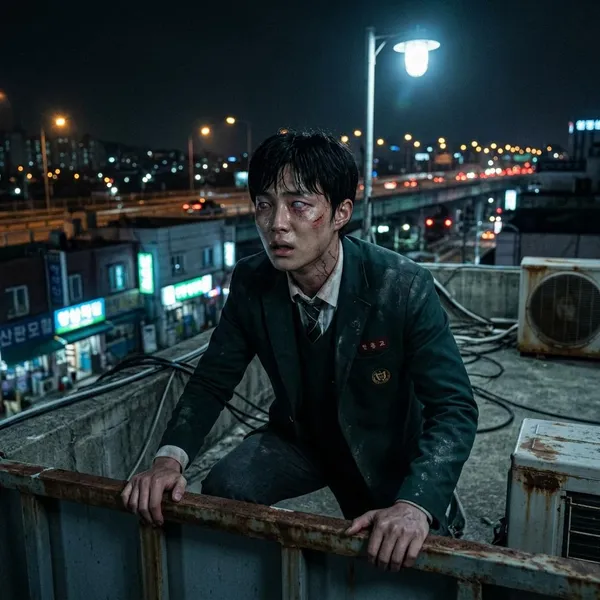
How does the outbreak begin in All of Us Are Dead?
The outbreak begins with Lee Byeong-chan's Jonas virus, but the first thing to remember is that the show does not treat it as a random lab accident. It comes from bullying, fear, revenge, and adults failing to stop violence before it mutates into something far worse.
- Byeong-chan creates the virus after his son is brutalized.
- Kim Hyeon-ju becomes the first major infected student inside Hyosan High.
- The school collapses because crowded rooms and slow adult reactions give the infection room to spread.
- The crisis reaches hospitals, emergency workers, streets, and eventually the whole city.
Lee Byeong-chan creates the Jonas virus
Lee Byeong-chan creates the Jonas virus after watching his son suffer bullying and deciding that fear itself is the enemy. His idea is twisted: instead of relying on adults, school rules, or justice, he tries to force the body to fight back through rage.
That choice sets the moral tone for the season. Byeong-chan is not just "the scientist who made the zombies." He is someone who answers cruelty with another kind of cruelty, and the disaster grows from that decision.
Kim Hyeon-ju becomes the first infected student
Kim Hyeon-ju is the infection point that brings the virus into ordinary school life. At first, her symptoms are treated like a strange medical or discipline problem, which is exactly the kind of delay that lets the outbreak get ahead of everyone.
The infection spreads through Hyosan High
Hyosan High turns into a trap because everything about a school helps the virus move: packed classrooms, narrow hallways, stairwells, lunch areas, and students running in groups without clear information.
- Noise attracts danger: panic pulls more infected toward the survivors.
- Closed rooms are temporary: a classroom feels safe until one window, door, or infected student changes that.
- Trust becomes risky: a bitten friend may still look human for a short time.
The outbreak reaches the wider city
Once the virus leaves Hyosan High, the story changes from a school survival thriller into a citywide emergency. Hospitals, police, parents, and rescue teams are no longer reliable outside help; they become part of the collapsing world.
How does the Jonas virus affect its victims?
The Jonas virus usually turns people into fast, aggressive zombies, but Season 1 becomes more interesting because that is not the only outcome. Some infected people keep their minds, their memories, and parts of their personality, which makes the conflict less predictable.
The practical way to read the virus is this: ordinary zombies create the crowd danger, while half-human infected characters create the personal danger. If you are tracking the plot twist rather than every chase scene, Nam-ra and Gwi-nam are the two names to remember.
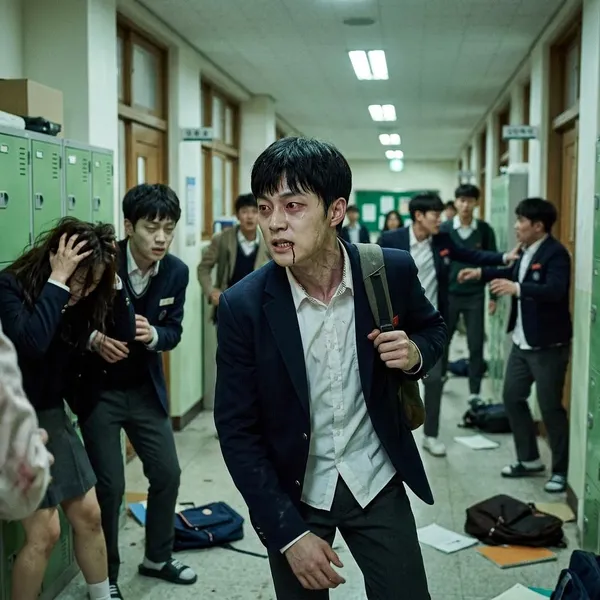
Most victims become aggressive zombies
Most infected people lose control quickly and attack the living. They are dangerous because they move fast, react to sound and movement, and spread the virus through close contact.
In low-risk scenes, distance and silence can buy the students a few seconds. In high-risk scenes, such as hallways or cafeterias, numbers matter more than bravery. One mistake can pull an entire swarm into the same space.
Some infected people keep their human minds
Some infected people become half-human instead of fully turning. They may still speak, think, remember grudges, and make choices, while also gaining infected traits that make them harder to stop.
That is why these characters feel more frightening than standard zombies. A regular zombie charges. A half-human infected person can wait, follow, lie, or target someone for personal reasons.
Strong emotions affect the mutation
The show strongly suggests that extreme emotion affects how the virus develops, though it never gives a clean scientific rule. Rage, humiliation, fear, loneliness, and obsession all seem tied to the half-human mutations.
This fits the origin of the Jonas virus. Byeong-chan built it around the idea of turning fear into violent survival, so it makes sense that emotional pressure keeps shaping what the infection becomes.
Half-human infections reshape the conflict
Half-human infections change the season because the survivors can no longer divide the world neatly into "human" and "zombie." Nam-ra proves that an infected person can still care, while Gwi-nam proves that infection can make an already cruel person even more dangerous.
For character-focused viewers, this is the real turning point of Season 1. The question stops being only "Who gets bitten?" and becomes "What kind of person comes out on the other side of the bite?"
How does All of Us Are Dead Season 1 end?
Season 1 ends with Hyosan bombed, a small group of students reaching quarantine, Nam-ra separating from the others, and a rooftop reunion that hints at more half-human survivors. The outbreak phase is contained, but the mutation story is not finished.
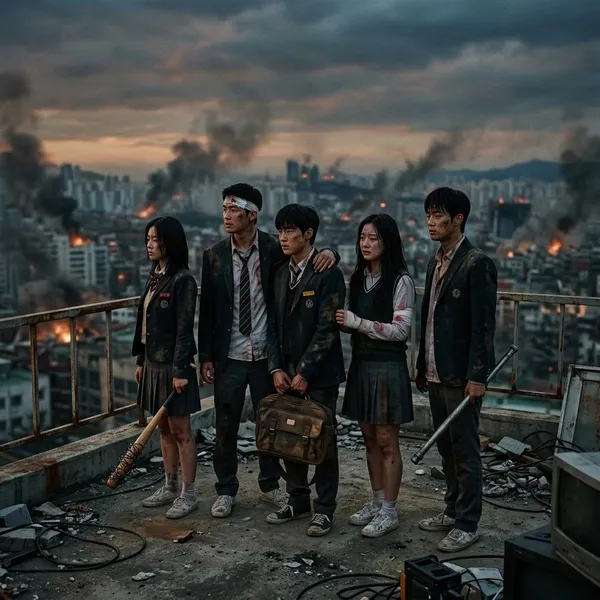
Hyosan is bombed to contain the outbreak
Hyosan is bombed because the authorities decide the virus cannot be controlled through ordinary rescue or quarantine measures. It is one of the harshest choices in the season: stop the spread outward, even if that means giving up on many people still inside.
The bombing also marks the point where the show stops offering easy rescue hope. The students are no longer just running from zombies; they are trying to survive a system that has already decided containment matters more than individual lives.
The remaining students reach quarantine
The surviving students eventually reach quarantine, but it is not a happy reset. They are alive, monitored, isolated, and left to process losses that cannot be fixed by rescue buses or military tents.
If you are checking the ending before watching a second season, quarantine is important because it closes the immediate escape arc. It does not solve the bigger questions about the virus, the half-human infected, or what the survivors can return to.
Nam-ra leaves the group behind
Nam-ra leaves because she understands that staying with the group could put them at risk. She still has her mind and feelings, but her hunger and half-human condition make ordinary human life unsafe.
Her choice is protective rather than villainous. She has become closer to the group than she was at the start, which makes leaving more painful, not less.
The survivors reunite on the school roof
The rooftop reunion gives the finale its quiet emotional payoff. The survivors return to a place tied to fear, waiting, and hope, and they find Nam-ra still alive in a form they do not fully understand.
The final scene reveals more half-human survivors
The final scene strongly suggests that Nam-ra is not the only half-human survivor. Her words point to others living outside normal quarantine control, which makes the mutation feel like the next stage of the story rather than a leftover detail.
That is the clearest setup for another season. Ordinary zombies can be fenced off or destroyed, but intelligent infected survivors create a much harder question: are they monsters, victims, a new community, or all three at once?
Conclusion
The best way to remember Season 1 is as a chain reaction: Byeong-chan's desperate experiment enters Hyosan High, the school outbreak becomes a city disaster, and the half-human mutations turn a zombie story into a question about identity. The bombing ends the first crisis, but Nam-ra's survival makes the ending feel deliberately unfinished, especially for anyone trying to judge what Season 2 has to answer.