Episode 6, "The Morrow," works because it treats the Trial of Seven as the beginning of the fallout, not the end of the story. The clean answer is that Dunk leaves Ashford carrying guilt, Egg chooses the road over royal protection, and Baelor's death turns what looked like a personal trial into a political wound for Westeros.
Why Dunk rejects a comfortable life
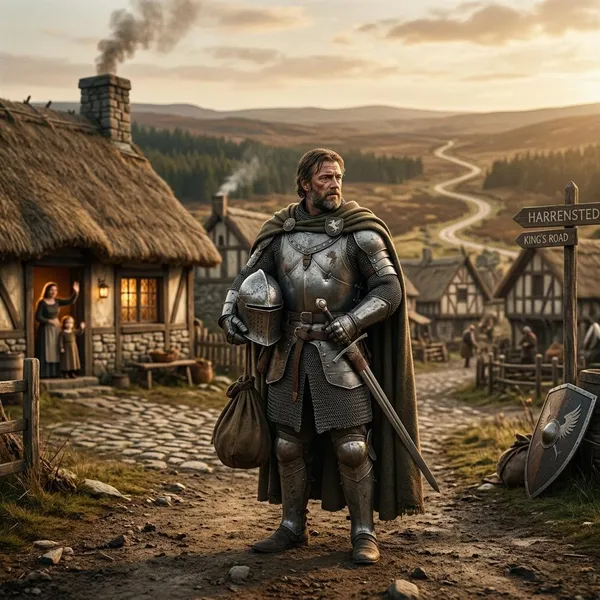
Dunk's choice is not just stubborn pride. He has offers that would make his life easier, but Ashford has shown him what comfort under powerful men can cost. For a hedge knight with no family name to protect him, taking patronage would mean trading hunger and uncertainty for obedience.
He feels responsible for Baelor's death
Dunk is not fairly to blame for Baelor's death, but he feels responsible because Baelor entered the Trial of Seven on his side. Praise after the trial cannot feel clean when a better-born, better-trained, and widely respected prince died in the same fight.
That guilt changes the meaning of survival. A less thoughtful knight might accept the reward and call the trial a victory; Dunk leaves with the sense that his life now carries a debt. The scene with Valarr makes that sharper because Baelor is not just a symbol of lost goodness. He was someone's father.
He distrusts life under powerful lords
Ashford teaches Dunk that noble attention is not the same as safety. A lord's household could give him meals, horses, and better gear, but it would also put his conscience inside someone else's chain of command.
- Lyonel's offer feels generous, but it still ties Dunk to a great house.
- Maekar's offer could raise Dunk's prospects, but it comes from a family still surrounded by grief and politics.
- The road is harder, yet it leaves Dunk free to refuse orders that feel wrong.
He wants to define knighthood for himself
Dunk has seen enough titled knights behave badly to know that a title alone does not make a man honorable. His version of knighthood is rougher and less polished: protect the vulnerable, keep your word, and stand where you think you must, even when it costs you.
That is why the Ser Arlan question still matters around Dunk. Whether the show is leaning into memory, insecurity, or the ambiguity of what Dunk inherited from his old master, Dunk's ideal of knighthood comes from the road rather than a court. He would rather be an imperfect hedge knight with a working conscience than a better-equipped servant of someone else's ambition.
He believes Egg needs real-world experience
Egg can learn names, ranks, and royal expectations in a castle. He can only learn how ordinary people live by traveling without the cushion of being treated like a prince.
That makes Dunk's rough life strangely valuable for him. Egg sees hunger, fear, unfairness, and kindness at ground level. If the boy is ever meant to carry power, that kind of education may matter more than another lesson in court manners.
Why Baelor's death matters
Baelor's death matters because it is personal grief and dynastic damage at the same time. The episode does not treat him as a shocking casualty who disappears once the plot moves on. His absence changes Dunk, Maekar, Egg, and the future shape of the Targaryen family.
Westeros loses a promising future king
Baelor is presented as the kind of Targaryen the realm could actually trust: controlled, intelligent, and capable of mercy without looking weak. Losing him is not only sad for the family. It removes a stabilizing figure from the line of succession.
Maekar must face his role in the death
Maekar did not intend to kill Baelor, but intent does not erase what happened. The episode keeps him in that uncomfortable space: not a cartoon villain, not an innocent bystander, and not a man who can simply call it an accident and move on.
His grief is complicated by public responsibility. He still has to act like a prince, a father, and a political figure while carrying the knowledge that his own blow ended his brother's life. That tension makes his scenes heavier than a simple apology could.
Dunk carries the guilt forward
Dunk leaves Ashford burdened, not healed. That matters for the larger story because guilt can make him both better and more difficult: more protective, more alert to injustice, but also more likely to blame himself for things outside his control.
The Targaryen line of succession changes
Baelor's death shifts the royal future, even if the episode does not pause for a full genealogy lesson. The point is not to memorize every possible claimant. The point is that one sudden death can rearrange which personalities, grudges, and weaknesses sit closest to power.
- For the family, it leaves grief mixed with blame.
- For the realm, it removes a respected heir.
- For Egg, it makes the world he belongs to feel more fragile than before.
What the ending with Egg means
The ending with Egg is hopeful, but it is not a clean reset. Dunk gets his companion back, Egg gets the life he wants, and the audience gets the central partnership restored. The catch is that Egg's return may not be fully approved, which turns a warm reunion into a new problem.
Egg chooses Dunk over royal life
Egg's choice says that he values Dunk's honesty more than the comfort of being protected by rank. He is not just running toward adventure. He is choosing a teacher, a friend, and a way of seeing the world that does not flatter him because he is royal.
Egg lies about Maekar's permission
The finale strongly suggests that Egg is not telling the full truth about Maekar's permission. That changes the mood of the ending from an arranged apprenticeship to something closer to a clever escape.
This makes Egg more active. He is affectionate and funny, but he is also capable of shaping events when adults try to decide his life for him. It also puts Dunk in a riskier position: if the permission is false, he may be traveling with a prince whose family did not actually release him.
Dunk gains a loyal squire
Dunk gains more than help with horses and armor. Egg becomes a companion who can challenge him, learn from him, and remind him that knighthood is not only about surviving the next job.
The relationship has a built-in tension that keeps it interesting. On the road, Egg serves Dunk. By birth, Egg outranks him. That reversal lets the story test both of them: Dunk has to lead without becoming arrogant, and Egg has to learn humility without losing his sharpness.
Their next journey begins with a new risk
The final ride is not just a charming image of a knight and squire heading into the countryside. Dunk is more visible than before, Baelor's death has shaken the royal family, and Egg may have slipped away under false pretenses.
- Low-risk reading: Egg has simply found the right mentor, and Maekar may tolerate it later.
- Higher-risk reading: Dunk is now responsible for a runaway prince at a politically sensitive moment.
That second possibility is what gives the ending its bite. The partnership feels right emotionally, but it may create trouble almost immediately.
What The Morrow means
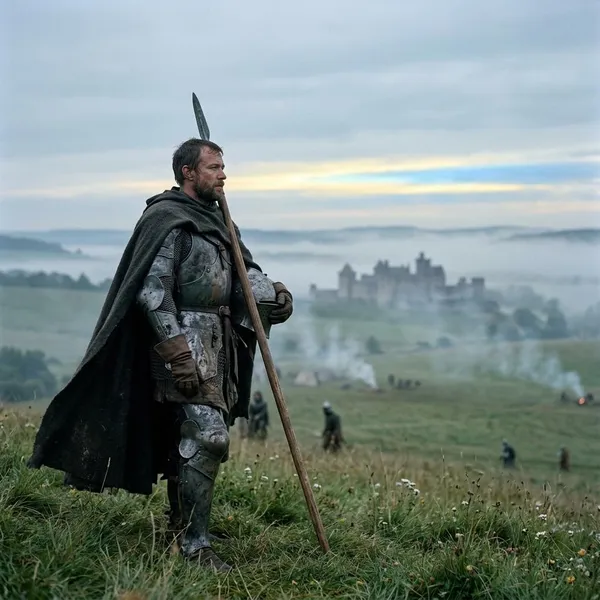
"The Morrow" means the next morning, but the title is doing more than marking time. It points to the day after violence, when the cheering is gone and everyone has to live with what the trial actually cost.
The morning after the Trial of Seven
On the literal level, the title refers to the day after the Trial of Seven. The bodies, bruises, lowered voices, and departures all belong to the immediate aftermath.
This is a smart structural choice. If the season ended at the moment of victory, Dunk's story would feel simpler than it is. By staying for the morning after, the episode shows that the trial solved the accusation but did not repair the damage.
The grief left by Baelor's death
The title also captures the way grief settles once the shock fades. Valarr's grief is raw, Maekar's is tangled with guilt, and Dunk's is tied to the feeling that he lived at someone else's expense.
Ashford itself feels changed. The tournament space that once promised noise, pride, and spectacle now feels emptied out. That contrast is one of the reasons the finale lands emotionally without needing another major action scene.
Dunk's uncertain future as a knight
For Dunk, the morrow is the first day of a less innocent life. He still wants to be a knight, but he has seen how easily knighthood can be used as decoration for pride, cruelty, or politics.
His future is uncertain in a practical sense too. He has no secure household, no rich patron, and no clear destination. What he does have is a firmer boundary: he knows the kind of service he does not want to give.
The start of Dunk and Egg's life together
The title is not only mournful. It also marks the beginning of Dunk and Egg as a chosen pair rather than an accidental arrangement.
That is the emotional balance of the finale. Baelor's death cannot be softened, but Dunk and Egg do not stay frozen in loss. They move forward with more knowledge, more danger, and a bond that now feels like the real center of the series.
How Episode 6 changes the book ending
Episode 6 keeps the heart of The Hedge Knight: Dunk mourns, Ashford ends, and Dunk and Egg leave together. The changes are mostly about television rhythm. The show gives the aftermath more room, lets supporting characters register more clearly, and adds uncertainty around Egg's departure.
The show expands the Ashford farewells
The finale spends more time on goodbyes and post-trial interactions than a compact page-to-screen transfer would need. That extra space helps the season breathe after the violence.
It also gives Dunk's departure more weight. He is not simply walking away from a tournament. He is leaving a social world where people judged him, helped him, doubted him, and changed the course of his life.
Supporting characters receive more closure
Characters such as Raymun, Lyonel, Daeron, and Valarr benefit from the added attention. They do not all need major new plotlines; they just need enough presence to feel like their lives continue after Dunk rides away.
This is one of the more useful adaptation choices. A novella can move quickly because the reader's focus stays close to Dunk. A television season usually needs a slightly fuller ensemble farewell so the ending does not feel abrupt.
Egg leaves without Maekar's approval
This is the most meaningful change. The book's version is more settled because Maekar's permission gives Dunk and Egg's arrangement a formal basis. The show's version makes Egg's choice feel bolder and more dangerous.
The final stinger creates a new conflict
The final beat prevents the season from closing too neatly. Dunk and Egg are together again, but the question of permission hangs over them.
The "Nine Kingdoms" joke helps keep the tone light while reminding viewers that the world is larger and messier than Ashford. It is a small joke with a useful job: the story can leave on warmth without pretending everything is safe.
- Main book-to-show change: the ending becomes less officially approved.
- Main benefit: Egg feels more decisive, not just assigned to Dunk.
- Main risk: Maekar's complexity may feel reduced if the permission issue is left too simple.
Conclusion
"The Morrow" is satisfying because it refuses to treat survival as a clean victory. Dunk leaves with guilt instead of glory, Egg chooses hardship over shelter, and Baelor's death makes the road ahead feel morally heavier than the road behind. The best way to read the ending is not as a reset, but as the moment Dunk and Egg become a true partnership under more dangerous circumstances.